
Guide two
Binoculars & Kit
Good binoculars make birdwatching easier, but you do not need much else. Here is how to read the numbers, set them up and use them quickly.
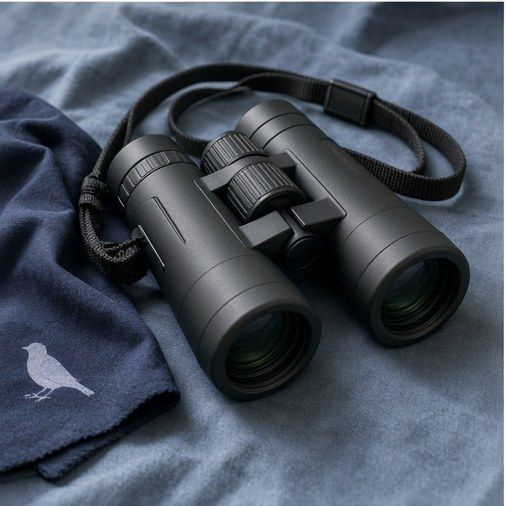
Reading the numbers
| Spec | Example | What it means for birding |
|---|---|---|
| Magnification | 8x | The bird looks eight times closer. 7x or 8x is steadier and easier for finding birds; 10x shows more detail but shakes more |
| Objective lens | 42 mm | Bigger lenses gather more light but add weight. 32 mm suits a light travel pair, 42 mm is the all-round choice |
| Exit pupil | 42 ÷ 8 = 5.25 mm | Higher is brighter in poor light |
| Field of view | about 120 m at 1,000 m | Wider makes it easier to find and follow moving birds |
| Close focus | 2 m | Short close focus helps with birds at feeders, and with butterflies |
What to look for when buying
- Try before you buy if you can. Comfort in the hand matters as much as specifications.
- Waterproof and fog-proof (often described as nitrogen- or argon-filled) is worth having outdoors.
- Eyecups that twist down, if you wear glasses.
- Skip zoom binoculars and very cheap toy-grade pairs. A modest, well-reviewed 8×42 beats both.
Setting them up in two minutes
- Fold the barrels until you see one round image.
- Close your right eye and focus on a sign or branch with the centre wheel.
- Close your left eye and turn the dioptre ring (usually near the right eyepiece) until the same target is sharp.
- Note the dioptre setting. From now on, focus with the centre wheel only.
Finding the bird
Keep your eyes on the bird and raise the binoculars into your line of sight, without looking down. Practise on a still object first. If you lose the bird, lower the binoculars, find it again with your eyes, and repeat.
The rest of the kit
- A regional field guide. One that covers only your country or region is easier than a world guide.
- A small notebook and pencil. Pencil works in the rain.
- Muted clothing that does not rustle.
- A recording app or website. Citizen-science platforms such as eBird let you keep lists and share sightings that help researchers.
Looking after binoculars
Blow or brush off grit before wiping lenses, then clean with a lens cloth. Keep the lens caps on in rain and dust, and store them dry.
Never look at the sun through binoculars, even briefly. It can cause permanent eye damage.